Like all living things, deer have three fundamental priorities: food, shelter, and water. Understanding deer needs is the first step in developing prime habitat for them. However, managing for one species at the expense of others is neither recommended nor wise. By understanding the needs of many wild animals and taking an approach that encourages diversity, the land can support a host of creatures that will add to people’s enjoyment as well. Fortunately, most practices that encourage white-tailed deer also add to the health and diversity of the landscape.
Deer are an edge species. They thrive with access to corridors and openings. Dense mature woodlands are not particularly attractive unless adjacent to openings or younger woods.
Many people in suburban areas understand that too many deer can be a huge problem. Too many deer means deer suffer from malnutrition and many other health problems. This can also negatively affect people through car accidents, tick infestations, and property damage. Therefore, the tools in this paper should only be used to encourage a healthy deer population to flourish.
Food Through the Seasons
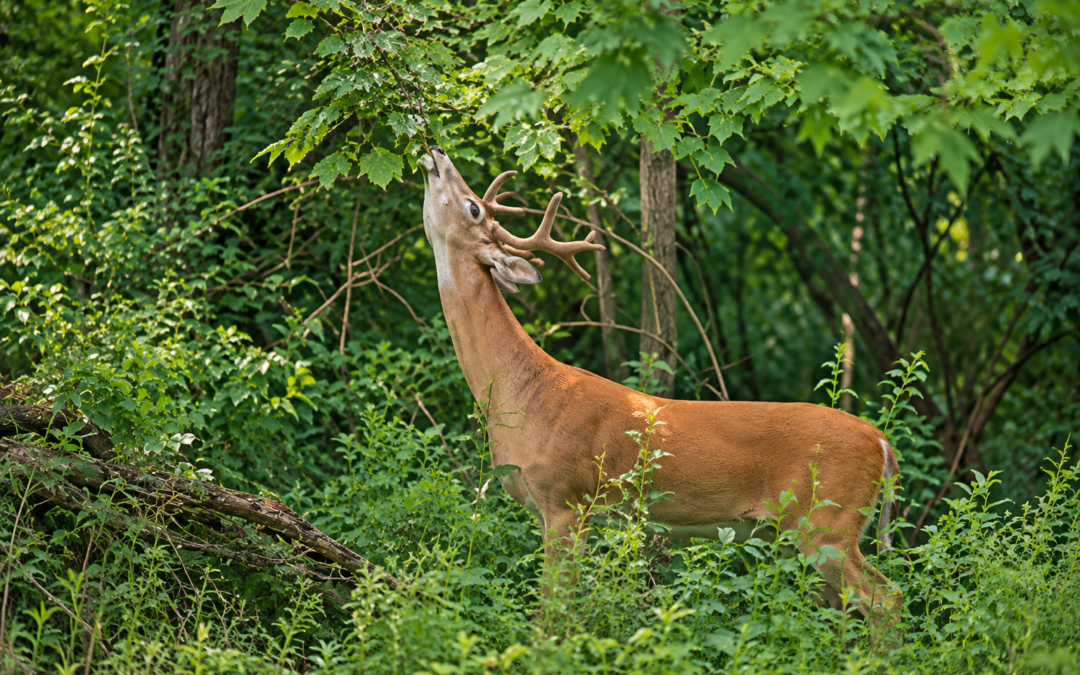
Deer eat a wide variety of plant parts. Deer are commonly known as browsers, often nipping off the buds of newly planted shrubs in yards. But deer only resort to browsing when more palatable vegetation is not available. They prefer the leaves of many shrubs and trees as well as sedges, clovers, and wildflowers. Acorns are perhaps their favorite food (Whitetails Unlimited, 1998). They will eat grasses, but generally prefer other plants.
In spring, deer move out of winter cover in search of early greens. They will eat new green buds of trees and shrubs as well as grasses and leaves. They particularly love young aspen (poplar).
Through the summer months, they continue to eat plants such as sedges, asters, clovers, alfalfa, sumac, goldenrod, bush honeysuckle, jewelweed, and various shrub and tree leaves. Deer prefer these food plants along forest edges and in open growing forests.
In the fall, deer turn to mast (acorns and other nuts). Fall is critical to deer as they eat these high-energy foods that will sustain them through the winter. Through the winter months, they will browse on dogwood, sumac, and willow or dormant or dried plant material on the ground if snow cover allows.
While food plots can help meet a deer’s needs, they often substitute for proper deer habitat management. Food plots meet only one of the animal’s core needs and usually only for part of the year. Proper design and management practices also matter. It is not always as simple as just planting some corn.
Large-scale management of the plant communities where deer live best addresses white-tailed deer food needs. The key to producing food is in creating diverse native plant communities. In most situations, the need for food plots to supplement deer nutrition, regardless of media attention, should be addressed only after the manager is satisfied that native plant communities are encouraged and maintained and deer densities are kept at levels the habitat can support. Only then do food plots occasionally have a place in deer nutrition management, depending on the manager’s goals. (Stevens, 2004)
 Cover
Cover
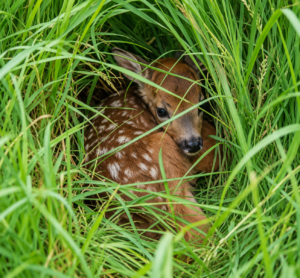
Deer prefer beds in locations where they are protected on one or more sides and can look towards perceived threats: under a large tree, behind a downed log, or near a pile of brush. They will bed in taller grasses and in drier locations in marshes and on brushy hillsides. Deer will maintain several beds and may choose a particular bed based on weather, threats, or other considerations. So, diverse cover types are useful.
Water
Deer get much of the water they need from the food they eat. Still, they often drink at streams or ponds, especially in warmer weather, so a water source is important.
Movement
Deer are ruminants like cattle. They eat and then retire to rest and chew their cud. Outside of breeding season, deer typically don’t move around much during the day, but that is not to say they don’t move at all. They typically rise from a bed, stretch, and perhaps feed briefly every few hours. If there are threats, they may move around quite a bit but will often hold to their cover until the threat is obvious.
At dusk they typically move along wooded corridors feeding along edges of openings or in open woods or ditches. As darkness approaches, they will often move into open meadows if available, where they may spend the entire night alternately feeding and resting. As dawn approaches, they will once again seek cover.
Habitat Management Considerations
A big threat to habitat quality in Minnesota is buckthorn. Buckthorn is an aggressive European species that invades woodlands. Along with exotic honeysuckle, it leafs out first in spring and drops its leaves last in fall. As a result, it initially shades out ground covers like sedges and wildflowers. As it takes over, it will affect native shrubs and young trees. Eventually, conifer, oak, and most shrub regeneration will be greatly disrupted. As mature trees die, no young ones will replace them, and eventually the woodland will revert to a brushy wasteland. Fortunately, most woods in northern and central Minnesota have not reached this stage, but without management it is a matter of time.
Deer typically do not use buckthorn woods for cover because they lack ground cover. While a buckthorn thicket may look dense to us, to a coyote it looks like an umbrella. Under the canopy is bare soil. Deer use buckthorn for food very little because it is generally unpalatable (Loos, 2013).
Deer thrive in a diverse landscape surrounding a forest matrix. In Minnesota, the criteria are as follows:
- Open woods with healthy ground covers and multiple age classes of trees and native shrubs
- Adjacent meadows or openings with legumes and wildflowers
- Brushy thickets of native shrubs and young trees away from roads and along the edges between forest and meadow
- Areas of tall grasses where practical
Therefore, a well-managed property will ensure that these structural elements exist in some form. On a given property, it may be possible to identify areas that already provide different needs. It is equally likely that developing good habitat will require an active approach of planting trees and shrubs, eliminating invasive species, and sometimes introducing prescribed fire.
While a classic pine forest is what people think of in central and northern Minnesota, a diverse woodland, particularly one with healthy oaks, native shrubs, and some young aspen (poplar) with some openings, is going to provide optimal habitat.
Call TruHabitats at 218-616-1981 to learn more about creating wildlife habitat!
References
Minnesota Department of Natural Resources (web brochure), Managing Your Woodland For White Tailed Deer
Loos, Ralph (10/16/2013). Outdoor News. Deer presence could be altered by common shrub
Stevens, Russel (9/2004). The Samuel Roberts Nobel Foundation (web article). Think before planting food plots
Whitetails Unlimited (1998). Brochure. Forest management for white-tailed deer.
By: Carl V. Korfmacher, 2026
