
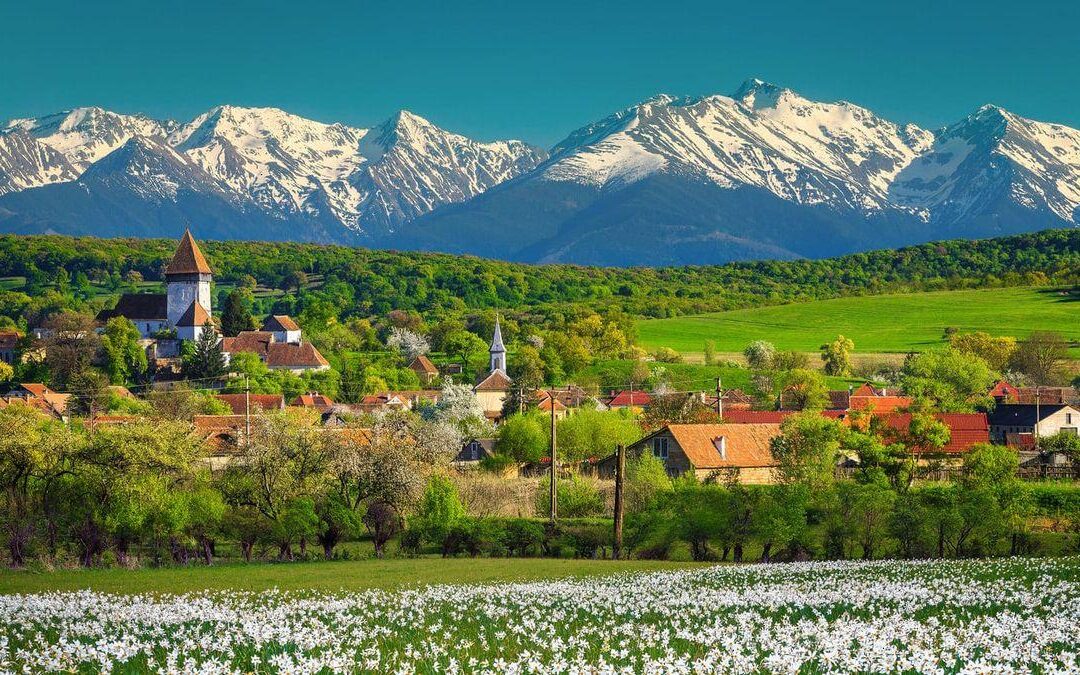
It feels like a lifetime ago, but only about a dozen years ago, I was on a team working on a U.S. Trade and Development grant to help the Romanian government develop sustainable environmental practices.
The tool we developed was simple but incredibly useful as Romania pursued entry into the European Union. Every grant request had to include a sustainability component addressing economic, ecological, and cultural considerations …. I won’t bore you with the details.
It was a great experience, though, and it helped me see environmental issues through the eyes of people who had very little practical experience with nature.
Getting to Romania Was Half the Adventure
My most interesting trip was the last one, though it certainly didn’t start that way.
My travel troubles began before I even left Milwaukee. Storms canceled all flights on my scheduled departure day, and the following evening brought even more delays. Eventually, the airline rerouted me through Charlotte and Paris before heading to Bucharest.
Unfortunately, the revised itinerary didn’t go much better, and I ended up stranded in Paris for about eight hours. I finally arrived in Bucharest around 11 p.m., where Mirela, one of our Romanian colleagues, had been patiently waiting for more than 12 hours. There was no time to waste, though, as we still had to catch a train to Targu Jiu.
The train station was abysmally dark. It reminded me of an old black-and-white noir movie. The engines weren’t steaming, but otherwise, it could have been 1932. Coach was nice enough, except the toilet had water in it, just like a toilet in your house! Best be careful, because if you were sitting on it when the train hit a bump, you were in for a splash.
There were six of us in the car. After about an hour, one of the passengers got up, said something, and pulled down two beds from each side. I got the top bunk. As we traveled through the Romanian countryside, I stared out the window. There wasn’t much to see. There were virtually no lights except at the train stations. I was reminded that this was the land of Dracula.
We arrived in Targu Jiu around 6 a.m. and reached the hotel shortly afterward. With only an hour before our first meeting, I hoped to catch a little shut-eye, but the local roosters had other plans. It was going to be a long day, and by 7 p.m., I was running on fumes. Unfortunately, the day wasn’t over yet. We still had dinner with the mayor ahead of us.
Dinner With the Mayor
Dinner was quite an affair: eight of us crowded into a small dining room, with the television blaring in the background. At the time, having a television was still considered a sign of wealth in Romania, a holdover from the communist era when few people owned one.
The evening began with a round of palinka, a home-brewed plum brandy Romanians are quite fond of, a tradition rooted in their peasant heritage. They typically served it from an old plastic Pepsi bottle, which didn’t exactly inspire confidence in its contents.
Lord knows what was in it. I don’t know what would have happened if I refused a shot, because I never did.
Our host was the mayor of Targu Jiu, a large regional center in the heart of western Romania’s former coal-mining country. He was a holdover from communist days, but he knew the score. Times were changing, and he wasn’t going to be looking for a job if he could help it. So he was changing too.
He was short, chubby, and garrulous. He knew how to entertain, and his wife and helper kept everything running efficiently from the kitchen. Across the table sat a dignified man from Bucharest’s environmental ministry. He was dressed in a tidy sweater and had brought his 12-year-old daughter along. Next to me was Lucica, a professor of water resources at Ovidius University, and Mirela, one of her students. Mirela was industrious and intelligent, and both women translated excellently.
Farther down the table was Tim, a professor of water resources at the University of Wisconsin–Milwaukee. Tim was the instigator of this whole adventure. He was fun to travel with, and I was happy to let him lead the U.S. delegation.
An Unexpected Turn of Events
As the evening progressed, things got louder, and the mayor was in full voice. He wandered around the table, topped off wine glasses, and asked everyone questions.At one point, he asked me if I liked to hunt and whether I owned any guns. I told him, “Yeah, I like to hunt, and I have a few guns.” He shouted something along the lines of,
“I too have a gun!”
With that, he trotted out of the room and returned a moment later carrying an AK-47.
He held it up, said something about it, and then handed it to the 12-year-old girl. She immediately pointed it at me. As I ducked under the table, her father deftly plucked the gun out of her hands.
He was embarrassed, I think, as much by the mayor, whose movements were getting a bit ragged from too much palinka, as by his daughter’s innocent mistake.
At least I assumed it was innocent.
I could have been wrong.
Environmental Work Is About People, Too
That experience has stayed with me over the years, and not just because of the unexpected dinner entertainment.
Working with the Romanian government on environmental sustainability gave me a different perspective on the relationship between people, natural resources, and the decisions we make about the land.
Whether you’re developing environmental policies in another country or working on land management and ecological restoration closer to home, understanding the people involved is just as important as understanding the environment itself.
Environmental work is about more than soil, water, plants, and animals. If you don’t understand people, you don’t understand much.
